Grinnell's Water Problem: What Homeowners Need to Know About Radium and Nitrates
If you live in Grinnell, Iowa, you may have already gotten a notice from the city about your drinking water — and it's worth taking seriously.
The Radium Problem Is Real, and It's Ongoing
In March 2026, the City of Grinnell received notifications for both the 4th quarter of 2025 and 1st quarter of 2026 showing the water system exceeds the federal maximum contaminant level (MCL) for combined radium, which is set at 5 pCi/L. The 4th quarter 2025 average came in at 7.79 pCi/L, and the 1st quarter 2026 average was even higher at 8.13 pCi/L — well above the legal limit.
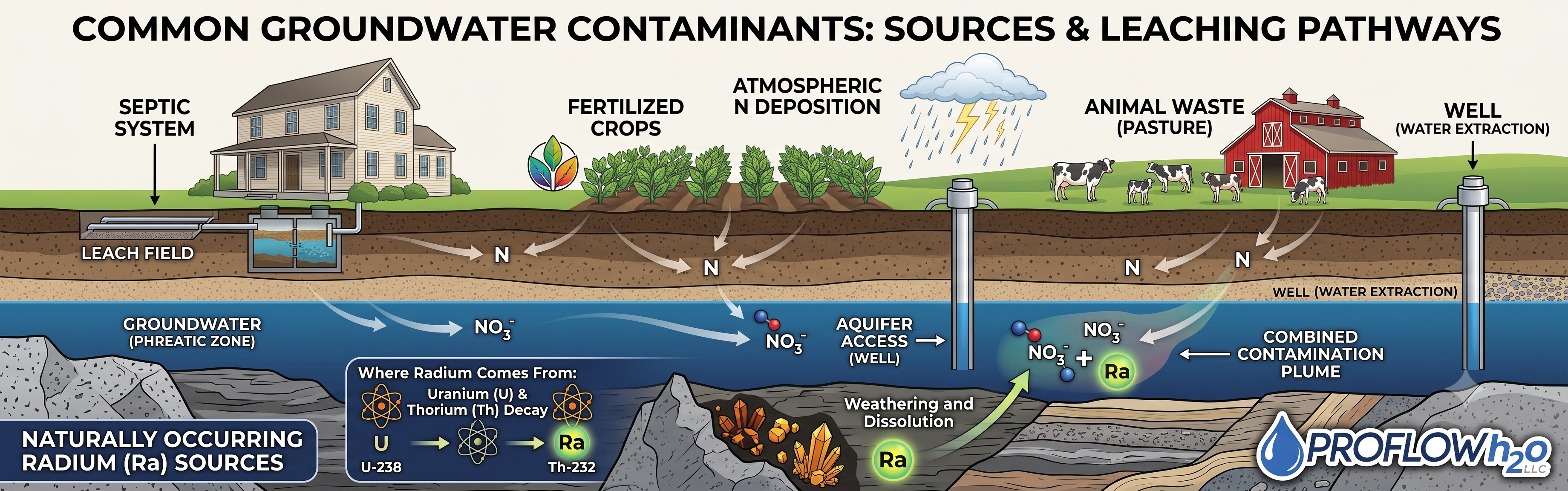
Radium occurs naturally in the water drawn from the Jordan Aquifer, which supplies Grinnell's water, and the city's current treatment plant doesn't have the capability to remove it. The city is building a new plant to address this, but that facility isn't expected to be operational until January 2027 — meaning residents are living with elevated radium in their tap water for the foreseeable future.
Why does that matter? Radium is a radioactive element, and the EPA regulates it because long-term exposure is linked to increased cancer risk. The city has been clear that this isn't a short-term emergency and the water remains safe for daily use, but it has also acknowledged that long-term exposure to elevated levels may carry some risk — which is exactly the kind of thing you don't want sitting in your family's drinking water for another year-plus while the city's fix gets built. (Grinnelliowa)
What Actually Removes Radium (and What Doesn't)
Here's something a lot of homeowners get wrong: boiling water and standard carbon-based filters do nothing to remove radium. The treatment methods that are actually effective are certain water softeners and reverse osmosis systems. That's a big reason a basic pitcher filter or fridge filter isn't going to solve this — you need the right kind of system, sized for your whole house.
Nitrates: The Regional Risk Beyond City Water
Nitrate contamination is a broader issue across Iowa's groundwater, largely tied to agricultural runoff and fertilizer use, and it's a growing concern statewide — Central Iowa Water Works has reported unusually high nitrate concentrations in 2026 across all three of its primary water sources, and researchers at the University of Iowa have specifically flagged this region: a University of Iowa-supported study found radium in private well water, and private wells aren't regulated under the Safe Drinking Water Act, meaning testing and treatment falls entirely on the homeowner..
That distinction matters — if you're on a private well anywhere around Grinnell rather than city water, nobody is testing or notifying you the way the city does for municipal customers. You're on your own to know what's in your water.
What This Means for Your Home
Between now and whenever the new treatment plant comes fully online, Grinnell households are left managing this risk on their own. The good news: it's a solvable problem with the right equipment.
ProFlowH2O's Complete Shield™ package was built specifically for situations like this — a whole-house system combining radium/mineral reduction with nitrate-selective treatment, plus a reverse osmosis system for your drinking water tap. One installation, both contaminants handled, and you're not waiting on a municipal construction timeline to protect your family.
And you don't have to pay for it all upfront — flexible financing is available, so you can get the system installed now and pay over time.
Sources: City of Grinnell Water & Wastewater Department water quality notices (March 2026), U.S. EPA Radionuclides Rule, Iowa CHEEC private well radium study, Central Iowa Water Works 2026 nitrate advisories.